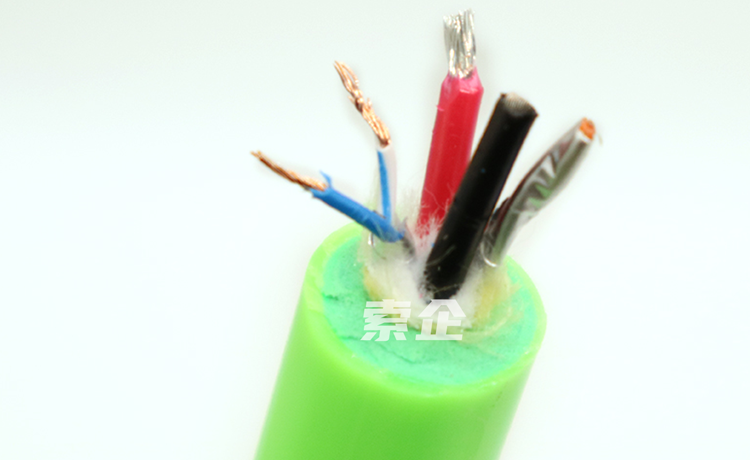
Category: Seawater-Resistant Cable
Hotline
Tel: +86 133 1175 6197
WeChat: L13311756197
Email: postmaster@suoqi-cable.com
Lightweight floating cables ensure stable signal transmission and are compatible with underwater monitoring equipment
1. Core Technology Breakthrough
1. Lightweight Buoyancy Control System
Precise control of foam layer density: Made with imported polyurethane (PUR) foam material, microbubble structure design achieves density gradient regulation, accurately matching overall density between freshwater and seawater (1.00-1.03g/cm³), ensuring the cable maintains a neutral buoyancy state underwater. This design prevents traditional cables from sinking or floating due to their own weight, making it especially suitable for scenarios sensitive to position accuracy, such as underwater sensor arrays and buoy systems.
Lightweight composite structure: The conductor uses multi-strand ultra-fine tin-plated copper wire (diameter ≤0.12mm), combined with a foamed thermoplastic elastomer (TPE) insulation layer, ensuring conductivity while reducing cable weight by more than 30% compared to traditional underwater cables.
2. Anti-Interference Signal Transmission System
Double-layer shielding anti-interference architecture: the inner layer uses aluminum foil mylar shielding (coverage ≥90%), and the outer layer is tin-plated copper wire braided shielding (density ≥85%), which can effectively suppress electromagnetic interference in the 100kHz-3GHz frequency range and ensure that the high-definition signal transmission attenuation rate of underwater cameras, sonar, and other equipment is less than 0.5dB/km.
Signal integrity optimization: The signal line twist spacing is strictly controlled between 8-12mm, combined with low dielectric constant insulation material (ε≤2.3), reducing signal crosstalk and transmission delay, supporting 1Gbps high-speed data transmission.
3. Deep Sea Environment Protection Technology
Multi-layer waterproof sealing structure: The inner layer uses a low-viscosity, high-strength extrusion-type TPE inner sheath, and the outer layer is an imported ultra-wear-resistant polyurethane (PUR) sheath. Combined with argon arc welding technology, it achieves IP68 waterproof rating (can withstand 50MPa water pressure, equivalent to a depth of 5000 meters).
Intelligent self-healing coating: The outer sheath surface is coated with an intelligent coating containing microcapsules. When the cable is scratched, the microcapsules rupture and release a repair agent that automatically fills the cracks; at the same time, a slow-release biocide can prevent the attachment and growth of algae and shellfish, reducing maintenance frequency.
2. Key Performance Indicators
Indicator name
Technical Parameters
Test standard
Operating voltage
Insulation resistance
Bending radius
Mobile installation: 7.5×D; Fixed installation: 4×D
Operating temperature range
-40°C to 90°C
Tensile strength
500-2000 kgf (customizable)
Buoyancy Adjustment Precision
Enterprise Standard Q/SQ 008-2025
Salt Spray Resistance
1000 hours corrosion-free
3. Subsea Monitoring Scenario Adaptation Plan
1. Marine Ecological Monitoring Buoy
High-density sensor network support: The cable can integrate 12-24 core signal lines, simultaneously transmitting data from water quality sensors (pH, dissolved oxygen), weather stations (wind speed, air pressure), and underwater cameras, combined with a fiber-optic composite structure to achieve long-distance low-loss transmission.
Dynamic buoyancy compensation design: When the draft of the buoy changes due to tides or load variations, the cable automatically adjusts the buoyancy through the elastic deformation of the foam layer, ensuring that the sensor array is always in the optimal monitoring position.
2. Submarine Pipeline Monitoring System
Distributed fiber optic sensing integration: The cable has built-in fiber Bragg Grating (FBG), which can monitor pipeline deformation, temperature, and stress changes in real time. Combined with the cable's zero-buoyancy characteristics, it achieves seamless bonding monitoring of the pipe surface with positioning accuracy of ±0.1m.
High-pressure and impact-resistant structure: The outer sheath uses a titanium alloy armored layer, capable of withstanding 10MPa of water pressure, and can maintain signal transmission stability even in extreme environments such as submarine mudslides.
3. Collaborative Operation of Underwater Robots
Multi-device parallel control: Cable integration of power lines (48V DC), signal lines (RS485/CAN), and optical fiber, supporting simultaneous control of ROV (remotely operated submersible) thrusters, robotic arms, and sonar systems, with response delay below 20ms.
Anti-tangle flexible design: The cable adopts an anti-twist layered structure, with a bending life of over 1 million times, which can prevent equipment failure caused by tangling when operating in narrow submarine cracks or coral reef areas.
4. Customized Service and Quality Assurance
1. Full-process customization capability
Customizable structure: supports personalized designs such as core wire count (2-24 cores), shielding type (split-screen/main screen), sheath color, and can integrate special functional modules such as fiber optics and coaxial cables.
Performance customization: Tensile strength (20-2000kg), waterproof depth (0-5000 meters), and operating temperature range (-100°C to 200°C) can be adjusted according to customer needs, with support for DNV GL, ABS, and more.
2. Strict quality control system
Material traceability: The purity of the conductor copper material ≥99.99%, and the sheath material has a density uniformity deviation of ≤±3% after passing UL94 V-0 flame-retardant foam layer.
Process control: Uses German-imported extruders with insulation thickness tolerance ≤±0.02mm. Each batch undergoes 3000V withstand voltage testing, 500 hours of salt spray testing, and 100,000 bend tests, with a defect rate controlled below 0.1%.
5. Typical Application Cases
The Yangtze River Estuary ecological monitoring buoy group Shanghai Suoqi lightweight floating cable provides power and signal transmission for 12 buoys, integrating a temperature-salt depth instrument (CTD), chlorophyll sensor, and ADCP (Acoustic Doppler Flow Profiling) to achieve real-time monitoring of water quality and flow velocity in the Yangtze River estuary, with data transmission stability reaching 99.98%.
The South China Sea oil and gas pipeline intelligent monitoring system cables are equipped with distributed fiber optic sensors laid along 30 kilometers of subsea pipelines, monitoring pipeline corrosion, stress, and submarine landslide risks in real time. Early warning response times are reduced to within 5 minutes, improving efficiency by 80% compared to traditional manual inspections.
The polar sub-ice scientific research robot provides stable power supply and signal transmission for polar research ROVs in -60°C low temperatures. The cable completes a 1000-meter drag operation through ice cracks, demonstrating excellent bending resistance and signal integrity, helping to obtain precious image data of Antarctic subglacial lakes.
Shanghai cable company's lightweight floating cable, with its lightweight design, excellent anti-interference performance, and deep adaptability, has become the core connection solution for underwater monitoring equipment. For detailed technical documentation or customized solutions, you can contact Shanghai cable companies directly via the official website or technical support hotline.
