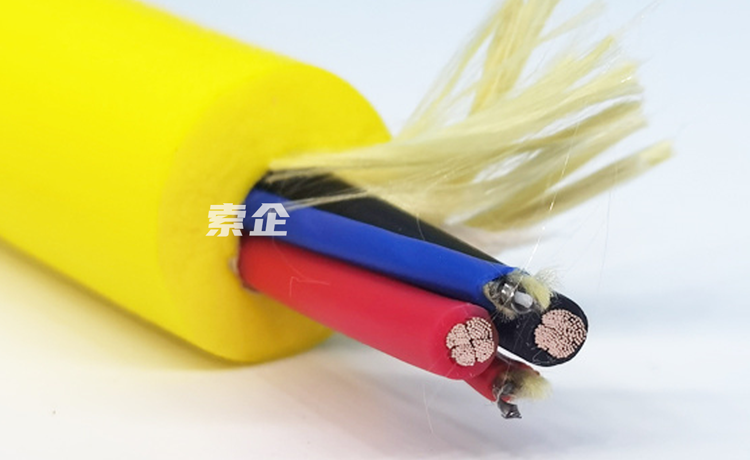
Category: Zero-Buoyancy Cable
Hotline
Tel: +86 133 1175 6197
WeChat: L13311756197
Email: postmaster@suoqi-cable.com
Shanghai cable company zero-buoyancy cable, dedicated signal transmission cable for underwater equipment
1. Product Positioning
Shanghai Suoqi's zero-buoyancy cables are specially designed for complex underwater scenarios such as underwater robots, marine monitoring equipment, and ROVs (remotely operated submersibles). Through precise buoyancy regulation and multi-layer protective structures, they achieve stable signal transmission and efficient equipment coordination, serving as the core connection solution for deep-sea exploration and underwater engineering.
2. Core Technology Advantages
1. Zero buoyancy precise adaptation technology
Density dynamic balancing process: Uses imported polyurethane (PUR) foam material and microbubble pore size control technology (average pore size ≤ 50μm), achieving precise matching of cable density with seawater/freshwater (1.00-1.03g/cm³), ensuring neutral buoyancy in water and avoiding equipment shifts or increased energy consumption caused by cable weight.
Lightweight structural design: The conductor uses multiple strands of ultra-fine tin-plated copper wire (single wire diameter 0.12mm) stranded together, combined with a foamed thermoplastic elastomer (TPE) insulation layer, reducing weight by 30% compared to traditional underwater cables and improving equipment flexibility.
2. Anti-Interference Signal Transmission System
Three-layer shielding protection:
Inner aluminum foil Mylar shielding (coverage ≥98%): isolates low-frequency electromagnetic interference;
Middle layer tin-plated copper wire braided (density ≥90%): resists high-frequency signal interference from 10kHz-3GHz;
Outer anti-torsion armored layer: woven aramid fibers, reduces signal loss during bending, transmission attenuation ≤0.3dB/km (1GHz).
3. Comprehensive Environmental Protection System
Double-layer sheath durability:
Inner sheath: High-toughness TPE material, waterproof rating IP68 (can withstand 50MPa water pressure, equivalent to 5000 meters underwater), resistant to low temperatures, does not become brittle at -40℃;
Outer jacket: Imported wear-resistant PUR material, surface hardness Shore A85, no corrosion after 1000 hours of salt spray test, UV aging resistant (QUV test 3000 hours, color difference ΔE≤2).
Tensile and torsion reinforcement: Built-in Kevlar fiber tensile core (breaking strength ≥200kgf), combined with a spiral braided structure, torsion angle ≤15°/m, suitable for high-frequency bending and dragging conditions of equipment.
3. Typical Structural Parameters
Structural layer
Materials / Craftsmanship
Technical indicators
Conductor
Multi-strand twisted tinned copper wire (compliant with VDE 0295 Class 6)
Conductivity ≥99.97% IACS, DC resistance ≤ 7.2Ω/km (16AWG)
Insulation layer
Foamed TPE Insulation Material
Dielectric constant ≤ 2.2, insulation resistance ≥ 1000 MΩ·km (20°C)
Shielding layer
Aluminum foil Mylar Tinned copper wire braid
Shielding efficiency ≥95dB (100MHz)
Tensile layer
Kevlar Fiber / Aramid Composite Core
Rated tensile strength 200-2000kgf (customizable)
Sheath layer
Inner layer TPE Outer layer PUR
Hardness Shaw A75-A85, wear resistance ≥500,000 cycles (Taber test)
Color
Red (other colors can be customized)
4. Key Performance Parameters
Project
Parameter values
Test standard
Operating voltage
Test voltage
Bending radius
Mobile installation: 7.5×D; Fixed installation: 4×D
Operating temperature
-40℃ to 90℃ (short-term 125℃)
Waterproof rating
IP68 (water depth 100 meters, continuous submersion for 30 days)
Flame retardant rating
Buoyancy Adjustment Precision
± 0.02g/cm³ (at seawater density 1.025g/cm³)
Enterprise Standard Q/SQ 008-2025
5. Typical Application Scenarios
1. Underwater Robots (ROVs/AUVs)
Multi-system collaborative control: Supports simultaneous transmission of control signals (RS485/CAN), high-definition video (HDMI/SDI), and power supply (24V/48V DC), compatible with robotic arms from brands like DeepSea and Schilling, with signal latency ≤15ms.
Complex terrain operations: Zero buoyancy features prevent cables from tangling coral reefs or pipelines, and the torsional structure ensures stable movement on the seabed at a 60° incline. This has been applied in South China Sea oil and gas field inspection projects.
2. Marine monitoring buoys/sensor arrays
Long-distance data transmission: Integrated single-mode fiber (optional), supports 20km relayless transmission, paired with distributed temperature sensors (DTS) to achieve real-time collection of ocean temperature and salt depth (CTD) data, with an error ≤0.1%.
Anti-biological adhesion design: The outer sheath is coated with nano-grade cuprous oxide to inhibit algae/shellfish adhesion, reducing manual maintenance costs by 60%, suitable for long-term monitoring in Arctic ice floating areas.
3. Underwater security and rescue
High-definition image transmission: The 6-core twisted structure supports 1080P high-definition camera signals. The shielding layer effectively filters out stray underwater current interference, maintaining clear images even in murky waters with visibility ≤ 1 meter. It has already been used in underwater inspections of the Hong Kong-Zhuhai-Macao Bridge.
Rapid deployment capability: Cables can be wound onto automatic retractor winches (cable capacity 500 meters), and together with ROVs, can achieve signal coverage at the accident scene within 30 minutes, helping to improve underwater search and rescue efficiency in Shenzhen Bay by 50%.
6. Customized services
Flexible core configuration: Supports any combination of 2-24 cores (power / signal / fiber optic / coaxial), and can integrate special functional modules such as air ducts and hydraulic pipes.
Deep Performance Customization:
Buoyancy range: 0.8-1.2 g/cm³ (suitable for freshwater / seawater / special liquids);
Tensile strength: 20-2000 kgf (Kevlar/steel wire rope reinforcement optional);
Sheath features: special formulas for oil resistance, acid and alkali resistance, radiation resistance, etc.
Support: Provided, DNV GL classification society meets the strict global environmental access requirements.
