Category: Products
Hotline
Tel: +86 133 1175 6197
WeChat: L13311756197
Email: postmaster@suoqi-cable.com
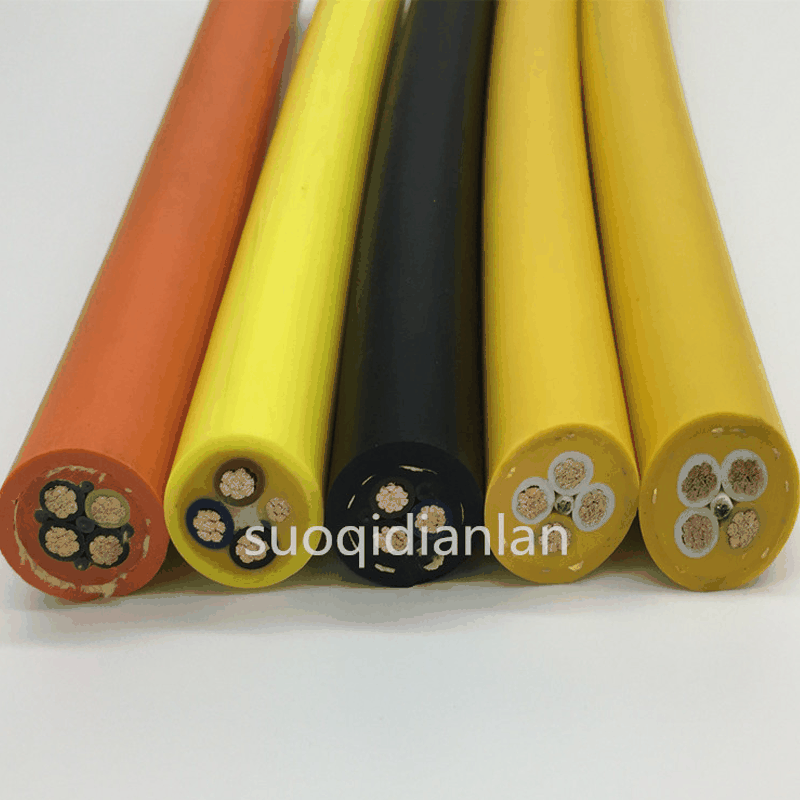
In harsh conditions such as mining and port loading and unloading, ordinary winding cables frequently suffer from sheath cracking, conductor core breakage, internal twisting and bulging, leading to equipment downtime and high replacement costs. Shanghai Cable Company reel cables are specially designed for these conditions, with conductors made of multi-strand ultra-fine oxygen-free bare copper wire strands (VDE 0295 CLASS 5/6 standard). The sheath uses imported polyurethane PUR composite, with double-layer sheaths reinforced with tensile braiding layers for twist and bulge resistance. The cables feature high flexibility, tensile resistance, and torsion resistance, and are widely used in machinery, mining, and underwater fields. Shanghai Cable Enterprises sells their cables directly from the source factory, customizing multiple cores and specifications on demand, with ample stock and nationwide shipping. Consultation hotline 13311756197.
Product Features
2. Excellent Environmental Adaptability Oil and Stain Resistant, Unafraid of Harsh Environments: Excavator operation sites are often accompanied by oil stains, sludge water, and other pollutants. The outer sheath of this cable is made of oil- and corrosion-resistant polyurethane (PUR) or nitrile rubber, which effectively resists corrosion from various oils and chemicals, prevents swelling and aging of the outer sheath, ensures long-term reliable operation in dirty environments, reduces maintenance frequency, and lowers operating costs.
3. Precise Signal and Power Transmission Low resistance conductor, efficient power transmission: The conductor uses high-purity oxygen-free copper with a purity of over 99.99%, featuring extremely low resistance, which greatly reduces power transmission losses and ensures efficient and stable power transmission from the power supply to the excavator motor. During high-power operation of large electric excavators, it ensures the motor receives sufficient power, delivers strong power, improves excavator work efficiency, and lowers energy costs.
Shielding and anti-interference, stable signal transmission: The excavator control system demands extremely high signal transmission stability. The cable is equipped with a dual-layer structure of aluminum foil shielding and tin-plated copper wire braided shielding, providing significant shielding and effectively blocking external electromagnetic interference, ensuring precise transmission of control and sensor signals, preventing excavator operation errors and loss of control caused by electromagnetic interference, and guaranteeing equipment safety and precision.
Personalized Customization: The Shanghai Suo Enterprise technical team can tailor cable parameters such as rated voltage, minimum bending radius, and protection level according to customers' special usage scenarios and technical requirements. For example, cables with higher protection ratings (such as IP68) can be customized for excavators operating on special sites, meeting their needs for use underwater or high-dust environments, providing customers with comprehensive and personalized cable solutions.
Application scenarios
Industrial automation, machinery manufacturing, port terminals, and mining operations
Customized services
Direct sales from Shanghai Suoqi cable factory source, supporting on-demand customization of multiple core counts and specifications. Ample stock available, nationwide shipping. Consultation hotline: 13311756197
Frequently Asked Questions
Can reel cables and drag chain cables be interchangeable?
No. Reel cables are designed for winding and unwinding, emphasizing torsion resistance and radial compression resistance; drag chain cables are designed for repeated bending, emphasizing bending fatigue resistance. The structural differences between the two are significant.
Why is a Kevlar tensile layer used in reel cables?
During winding and unwinding, the cable is subjected to continuous axial tension. Aramid/Kevlar tensile fibers can share the tension, preventing the conductor from being elongated or deformed and ensuring stable electrical performance.
Related product recommendations
Shanghai Suoqi Reel Cable
Reel Cable — Life Optimization of Cables under Frequent Winding Conditions
