Category: Products
Hotline
Tel: +86 133 1175 6197
WeChat: L13311756197
Email: postmaster@suoqi-cable.com
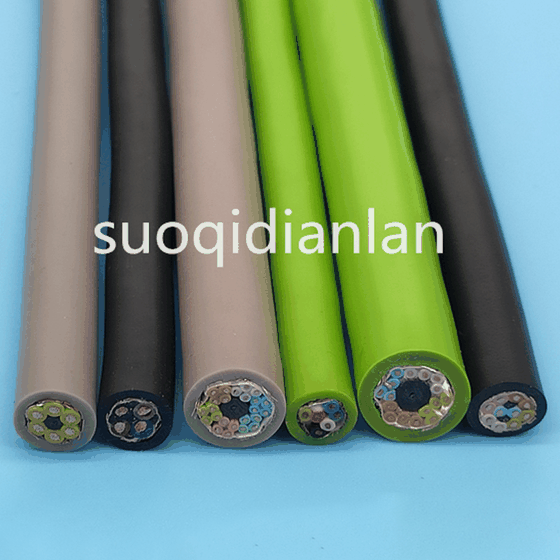
Servo encoder systems have stringent requirements for signal transmission accuracy. Ordinary cables have weak anti-interference ability, and environmental electromagnetic noise can cause signal crosstalk and packet loss, severely affecting positioning accuracy. Shanghai Suoqi encoder cables are designed for pulse signal transmission conditions in elevators and overhead cranes, featuring torsion-resistant and twist-able structures, individually shielded twisted pair signal lines, polyurethane imported jackets, and small bending radius, suitable for high-precision signal transmission in servo encoder systems. The cables have characteristics such as high flexibility, bending resistance, and wear resistance, and are widely used in automation, servo, machinery, and other fields. Shanghai Suoqi cables are sold directly from the source factory, can be customized with multiple cores and specifications, are available in stock for nationwide delivery, and the consultation hotline is 13311756197.
Product Features
Precision Stranding Process: The control wire pair uses a separate stranding method. By precisely controlling the twisting pitch, it effectively reduces crosstalk interference during signal transmission, ensuring accurate transmission of control signals and enabling the servo system to control the motor with higher accuracy. The twisting density between the power core and control wire pair is optimized to ensure extremely low signal attenuation during long-distance cable transmission, meeting the cabling needs of industrial production scenarios of different scales.
3. Strong Anti-Interference Capability Double-Layer Shielding Structure: Equipped with aluminum foil shielding and a tinned copper wire braided shielding layer. The aluminum foil shielding can effectively block low-frequency electromagnetic interference, while the tinned copper wire braided shielding provides excellent protection against high-frequency interference. The combination of both ensures that the cable can maintain uninterrupted signal transmission in complex electromagnetic environments, such as when numerous electrical devices are operating simultaneously in a large factory, thereby maintaining stable operation of the servo system and preventing issues such as motor malfunctions or control signal distortion caused by electromagnetic interference.
4. Adaptable to Multiple Application Scenarios Machine Tool Manufacturing Field: Used in equipment such as CNC machine tools and machining centers to connect servo motors and control systems. During the machining process, the motor requires frequent start-stop and speed changes, placing very high demands on the cable’s signal transmission stability and flexibility. This cable can ensure that control signals are transmitted quickly and accurately, allowing precise motor response and ensuring machining accuracy and efficiency of the machine tool.
Industrial Robot Application: Suitable for connecting various joints of industrial robots with the control system. Robots have complex movement trajectories during operation, requiring cables to frequently bend, twist, and stretch. The high flexibility and durability of this cable can meet the long-term high-intensity working requirements of robots, ensuring smooth robot movements, precise control, and reducing downtime for maintenance caused by cable failures.
Application scenarios
Industrial automation, machinery manufacturing, port terminals, and mining operations
Customized services
Shanghai Suoqi Cable offers encoder cable selection guidance and on-demand customization services, capable of producing multiple cores and specifications, with flexible combination of spot and futures stock. For details, please inquire 13311756197 (WeChat same number).
Frequently Asked Questions
How should encoder cables be routed?
They should be routed separately from power lines, avoid long parallel runs, and, if necessary, use metal drag chains for separation to reduce crosstalk risk.
What is the impedance of encoder cables?
The commonly used characteristic impedance is 100±15Ω, which needs to match the encoder interface. Impedance mismatch can cause signal reflection and positioning drift.
Related product recommendations
Encoder cables — Maintenance of servo feedback system encoder cables
Selection and Application Guide for Encoder Cables
Application of encoder cables in construction scenarios
Selection Tips
This solution corresponds to pulse signal transmission between elevators and overhead cranes, with torsional resistance and winding resistance as core design criteria, and a multi-core combination specification range. Bulk procurement can provide technical agreements and factory inspection reports.
