Category: Products
Hotline
Tel: +86 133 1175 6197
WeChat: L13311756197
Email: 923312606@qq.com
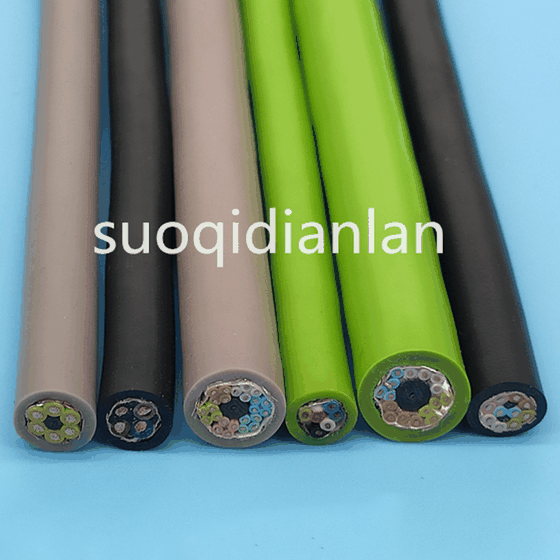
The key to selecting encoder cables is the working conditions. Shanghai cable encoder cables use ultra-fine oxygen-free copper wire stranded (CLASS 6) conductors, with twisted shielding aluminum foil, tin-plated copper braiding, total shielding, PUR outer sheath, anti-crosstalk sound preservation, and core advantages such as high flexibility, wear resistance, and oil resistance, widely applicable to automation, servo, CNC scenarios, and more. Direct sales from the source manufacturer with stable delivery times. Welcome to call 13311756197 for selection plans.
Product Features
Twisted pair structure, crosstalk interference resistance: The cable cores are designed in twisted pairs, and this differential signal transmission method has excellent crosstalk resistance. In complex multi-core cable wiring environments, the issue of mutual interference between signals of different cores is effectively suppressed, ensuring that each encoder signal can be transmitted purely and stably, providing a reliable data foundation for precise control of the servo system.
2. Outstanding High Flexibility and Durability High flexibility design, suitable for complex working conditions: Whether in fixed installations or applications where equipment is frequently moved, this cable can handle it with ease. The conductor is treated with a special process, making it soft yet resilient. Even after repeated bending and twisting, it does not break. At the joints of industrial robots, where the cable must follow the complex trajectories of the robotic arm, Shanghai Suoqi servo encoder cables, with their excellent flexibility, can work reliably over the long term, reducing the risk of equipment failure caused by insufficient cable rigidity.
3. Strong Anti-Interference Capability Double-layer Shielding Protection to Block Electromagnetic Interference: Equipped with a dual-layer structure of aluminum foil shielding and tinned copper wire braided shielding. The aluminum foil shielding can effectively block low-frequency electromagnetic interference, while the tinned copper wire braided shielding provides strong protection against high-frequency interference, with a braiding density of 85% or higher. This ensures that in complex electromagnetic environments, such as in large factories where numerous electrical devices operate simultaneously generating strong electromagnetic radiation, the encoder signals transmitted inside the cable are not affected by external interference, ensuring stable operation of the servo system and preventing equipment malfunctions caused by electromagnetic interference.
4. Flexible Customization to Meet Diverse Needs Rich Options in Core Count and Cross-Section: Offers a variety of options from single-core to multi-core (such as 2-core, 3-core, 4-core, 5-core, etc.), meeting the connection requirements of different servo encoder systems; the range of conductor cross-sectional areas is extensive, from 0.2mm² to 100mm² or even larger specifications, which can be customized to precisely match different signal transmission and power requirements, ensuring accurate transmission of encoder signals and stable power supply for related equipment.
Application scenarios
Industrial automation, machinery manufacturing, port terminals, and mining operations
Customized services
Shanghai Suoqi Cable offers encoder cable selection guidance and on-demand customization services, capable of producing multiple cores and specifications, with flexible combination of spot and futures stock. For details, please inquire 13311756197 (WeChat same number).
Frequently Asked Questions
Why do encoder cables emphasize double shielding?
The encoder transmits high-frequency weak signals, and dual shielding (braided mesh and aluminum foil) can achieve shielding attenuation of over 70dB, effectively resisting interference from inverters and motors.
How should encoder cables be routed?
They should be routed separately from power lines, avoid long parallel runs, and, if necessary, use metal drag chains for separation to reduce crosstalk risk.
Related product recommendations
Industrial automation tensile design for encoder cables
The bending life of encoder cables in warehouse logistics
Shanghai Suoqi Encoder Cable (Elevator and Overhead Crane Shaft Control Feedback Connection · Acid and Alkali Resistant)
