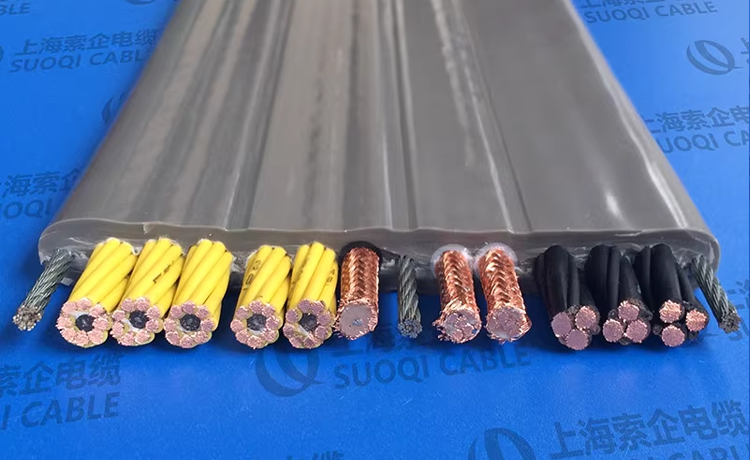
Category: Flat Cable
Hotline
Tel: +86 133 1175 6197
WeChat: L13311756197
Email: postmaster@suoqi-cable.com
Shanghai Suoqi cold-resistant flat cable and drag flat cable product introduction
In various complex industrial environments and special operation scenarios, the requirements for cable performance are becoming increasingly stringent. Shanghai Suoqi, relying on its deep technical expertise and innovative spirit, has meticulously developed cold-resistant flat cables and drag flat cables to meet the demands of different fields for efficient and reliable power transmission and signal connection, providing solid support for the stable operation of equipment.
1. Cold-Resistant Flat Cables: The Power "Messengers" in Extreme Cold Environments
(1) Excellent cold resistance
Shanghai Suoqi cold-resistant flat cables are specially designed for low-temperature environments and can operate normally in extreme cold conditions as low as -40℃. Their insulation and sheath are made of special cold-resistant materials, such as cold-resistant polyurethane (TPU) or cold-resistant rubber. These materials maintain good flexibility and elasticity even at low temperatures, without becoming hard or brittle due to the cold, ensuring stable transmission of power and signals in extremely cold regions, such as outdoor projects in northern winters or internal connections of cold storage equipment, effectively preventing equipment failures caused by the impact of low temperatures on cable performance.
(2) High flexibility and bending resistance
The internal conductors of the cable are made of multiple finely twisted oxygen-free copper wires, meeting high flexibility standards and giving the cable excellent bending performance. In practical use, whether it's mobile equipment that bends frequently or situations requiring wiring in confined spaces, cold-resistant flat cables can easily handle these issues. Their flexible structure effectively reduces stress concentration caused by bending, greatly extending cable service life, lowering maintenance costs and replacement frequency, and performs excellently in scenarios such as frequent lifting operations of port container cranes in low-temperature environments and automated logistics equipment shuttling through cold storage facilities.
(3) Good mechanical properties
In addition to being cold-resistant and flexible, this cable has excellent mechanical properties. The sheath material is not only cold-resistant but also has high wear resistance and tear strength, capable of withstanding scratches and impacts from sharp external objects, as well as mechanical wear in complex environments. At the same time, the cable incorporates high-strength tensile elements, such as Kevlar fibers or galvanized steel wires, to enhance the overall tensile strength of the cable, allowing it to maintain structural integrity during long-distance installation or when subjected to significant pulling force, ensuring stable power transmission. It is suitable for power connections of various large outdoor equipment in low-temperature environments.
2. Drag Chain Flat Cable: A Reliable 'Partner' for Mobile Power Supply
(1) Resistant to frequent movement and bending
Drag chain flat cables are mainly used in situations where equipment needs to move frequently and the cables need to be repeatedly bent and gathered, such as in cranes, hoists, and electric hoists. Shanghai Suoqi drag chain flat cables are specially designed and processed, with an internal structure that is compact and reasonable, and a harmonious fit between the conductors and the insulation layers. During long-term repeated bending, each layer of the structure can work together, effectively distributing stress, reducing internal wear, and ensuring stable cable performance. Even under high-frequency movement operations, they can reliably provide power and signal transmission for equipment, ensuring continuity and efficiency in production operations.
(2) Excellent anti-interference capability
In industrial production environments, electromagnetic interference is common and may affect the normal operation of equipment. Towling flat cables use shielding designs that wrap a metal shielding layer outside the insulation layer, such as copper wire braided shielding or aluminum foil shielding, effectively blocking external electromagnetic interference from affecting internal signals while preventing electromagnetic radiation generated by the cable itself from interfering with external equipment. This characteristic makes the cable suitable for automated production lines and precision processing equipment with extremely high requirements for signal transmission stability, ensuring accurate control signals and improving production accuracy and product quality.
(3) Waterproofing, dustproofing, and corrosion resistance
Considering that drag flat cables are mostly used outdoors or in relatively harsh industrial environments, Shanghai Suoqi has equipped them with waterproof, dustproof, and corrosion-resistant sheaths. High-quality rubber or polyurethane sheaths tightly wrap the internal structure of the cable, providing good sealing performance, effectively preventing moisture, dust, and various corrosive substances from entering the cable. Whether on humid construction sites, dusty mining sites, or chemical workshops with corrosion risks, drag flat cables can operate stably, adapt to different harsh environments, extend the service life of the cable, and reduce the risk of equipment downtime caused by cable failures.
3. Extensive Application Fields
(1) Industrial Automated Production Line
In modern industrial automated production lines, equipment requires frequent movement and precise control. Shanghai Suoqi's cold-resistant flat cables and drag chain flat cables play a key role. Cold-resistant flat cables can be used in automation warehousing equipment in low-temperature environments, ensuring efficient storage and handling of goods in cold storage environments; drag chain flat cables provide stable power and signal connections for moving robotic arms, conveyor carts, and other equipment on the production line, ensuring smooth operation of the entire production line and improving production efficiency and automation level.
(2) Ports and Logistics Equipment
Port cranes, gantry cranes, and other equipment operate frequently, requiring extremely high durability and reliability for cables. Thanks to their resistance to frequent movement and bending, drag flat cables can operate stably in harsh port environments, providing power support for equipment. In northern cold regions, cold-resistant flat cables can be used for loading and unloading equipment in low-temperature environments, ensuring normal winter port operations and improving cargo throughput capacity. In logistics warehouses, shuttle trucks, stackers, and other equipment also rely on these cables for efficient power transmission and signal control, optimizing logistics warehousing processes.
(3) Construction machinery
Construction sites are complex, and machinery such as tower cranes and hoists need to be frequently moved and lifted. Tow flat cables can meet the power supply and signal transmission needs of these devices during construction, and their waterproof, dustproof, and corrosion resistance are suited to the harsh conditions of construction sites. In cold regions, cold-resistant flat cables ensure that machinery operates normally in low-temperature environments, guaranteeing project progress without being affected by low temperatures and providing reliable support for smooth construction progress.
(4) Mining Equipment
The mining operation environment is harsh, with many unfavorable factors such as dust, dampness, and mechanical vibrations. The anti-interference, waterproof, dustproof, and corrosion-resistant properties of flat drag cables make them suitable for electric mining equipment, transportation equipment, and other machinery in mines, ensuring stable operation in complex environments. In mines located in the cold northern regions, cold-resistant flat cables can be used for outdoor mining equipment and equipment connections in low-temperature areas of underground mines, ensuring that mining operations are carried out safely and efficiently under severe cold conditions.
4. Reliable technical parameters
(1) Electrical parameters
Rated voltage: The rated voltage of cold-resistant flat cables and towing flat cables varies depending on the model and application scenario, covering various specifications from 0.6/1kV to 10kV, meeting the power needs of various equipment and ensuring stable and safe power transmission at rated voltages.
Insulation resistance: Both types of cables have high insulation resistance, with resistance not less than 1000MΩ per kilometer under normal conditions, effectively reducing leakage risks, ensuring power transmission efficiency, and guaranteeing safe and reliable equipment operation.
Short-circuit current carrying capacity: It has good short-circuit current capacity, allowing it to withstand large currents in a short period during a short circuit, preventing cable damage due to overheating, buying time for fault diagnosis and handling, and ensuring the safety of the power system.
(2) Structural parameters
Conductor: All use multi-strand finely stranded oxygen-free copper wire, meeting high flexibility conductor standards, such as VDE 0295 CLASS 5 or 6. This conductor structure not only has good conductivity but also meets the flexibility requirements of cables during frequent bending and movement.
Insulation: Cold-resistant flat cables use cold-resistant insulation materials, such as specially formulated polyvinyl chloride (PVC) or ethylene-propylene rubber (EPR); Drag flat cables use high-strength, wear-resistant insulation materials, such as modified polyurethane (TPU) or nitrile rubber (NBR). The insulation thickness is reasonably designed according to cable specifications and usage environments to ensure good electrical insulation and mechanical protection.
Shielding: Some models of flat cable have a shielding layer, with a braiding density of no less than 85% (copper wire braided shielding) or aluminum foil shielding coverage not less than 95%, effectively shielding external electromagnetic interference and ensuring signal transmission stability.
Sheath: Cold-resistant flat cable sheaths use materials with good cold resistance, wear resistance, and weather resistance; Tow flat cable sheaths emphasize wear resistance, waterproofing, dustproofing, and corrosion resistance. Sheath colors are usually black, but other colors can be customized according to customer requirements for easy identification and management.
Reinforcements: To enhance the cable's tensile performance, internal reinforcements such as Kevlar fiber and galvanized steel wire are added. The selection and configuration of reinforcements are determined according to the cable's actual usage scenario and tensile requirements, ensuring the cable maintains its structure under high tensile forces.
(3) Bending Radius and Installation Requirements
Minimum Bending Radius: For cold-resistant flat cables, the minimum bending radius is 5× the cable outer diameter for fixed installation, and 8× the cable outer diameter for mobile installation; for drag-chain flat cables, the minimum bending radius is 4× the cable outer diameter for fixed installation, and 6× the cable outer diameter for mobile installation. Adhering to the minimum bending radius requirement during actual installation and use can effectively protect the internal structure of the cable and extend its service life.
Installation Methods: Both types of cables are suitable for various installation methods, such as tray laying, conduit laying, and drag-chain system installation. During installation, attention should be paid to avoid excessive pulling or twisting of the cables, ensuring that the cables are installed firmly and neatly, in compliance with relevant electrical installation standards.
