Category: Reel Cable
Hotline
Tel: +86 133 1175 6197
WeChat: L13311756197
Email: postmaster@suoqi-cable.com
Introduction to reel cables for automated production lines in Shanghai cable enterprises
Driven by the wave of Industry 4.0, automated production lines have become the core force of modern manufacturing with their efficient and precise production models. Their equipment operates relying on the coordination of numerous precision electrical components. As the "nerve vessels" of power and signal transmission, reel cables must maintain stable performance during high-frequency, multi-directional continuous movement. Shanghai cable companies have deeply understood industry needs and launched reel cables for automated production lines. With highly flexible structural design and stable signal transmission performance, they lay a solid foundation for reliable power and data transmission in automated production, helping enterprises improve production efficiency and reduce equipment failure risks.
1. Core Performance: The perfect combination of high flexibility and stable transmission
(1) Extremely high flexibility, suitable for complex operating conditions
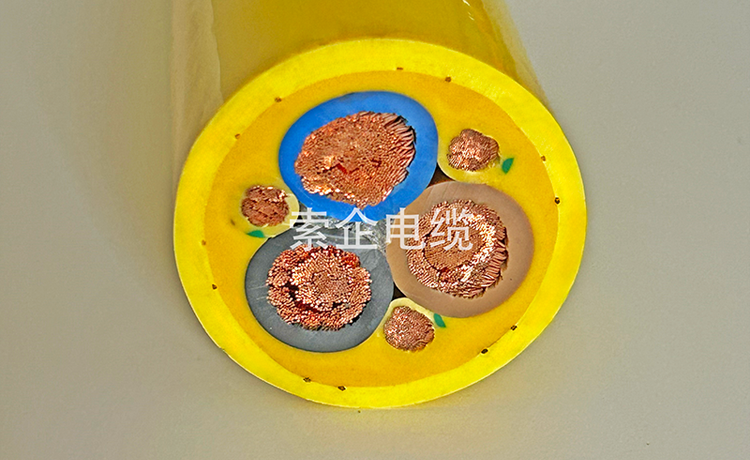
Flexible conductor structure: Uses a multi-strand fine oxygen-free copper wire stranding process, with a conductor diameter only one-third that of ordinary cables. Combined with a high-elasticity TPE inner sheath, the cable boasts outstanding flexibility. In scenarios such as high-frequency swinging of robotic arms on automated production lines and continuous winding of conveyor belts, the cable can flexibly bend with a minimum bending radius of 5D (D is the cable outer diameter), and after 2 million bending tests, the structure remains intact, effectively preventing conductor breakage or insulation damage caused by excessive bending.
Tensile Cushioning Design: Internally, an aramid fiber woven layer and high-elasticity polyurethane cushioning fill are added to form a three-dimensional tensile protection system. When cables move rapidly under the traction of automated equipment, aramid fibers can disperse tensile forces up to 500N, while the cushioning and filling layer absorbs impact forces from movement, ensuring stable electrical performance even under complex motion trajectories.
(2) Stable signal transmission to ensure precise production operation
Shielding and anti-interference technology: To meet the signal transmission needs of PLC control systems, sensors, servo motors, and other equipment in automated production lines, a double-layer shielding structure is adopted—an inner layer of aluminum foil shielding combined with an outer layer of tin-plated copper wire braided shielding, achieving a shielding coverage rate of up to 99.8%. Whether it is high-frequency electromagnetic interference, static interference, or crosstalk between devices, it effectively isolates data transmission accuracy and stability, preventing equipment malfunctions or production errors caused by signal distortion.
Low capacitance and low latency: Optimized cable insulation materials and structural design, controlling capacitance per unit length at ≤50nF/km, reducing signal transmission delay by 30%, ensuring rapid response to control commands and feedback signals on automated production lines, meeting the demands of high-precision, high-speed production scenarios.
2. Diverse scenario adaptation, covering fully automated production processes
(1) Dedicated cables for intelligent robotic arms
On automated assembly lines in industries such as automotive manufacturing and 3C electronics, robotic arms need to perform precise grasping, welding, and spraying operations within confined spaces. With its high flexibility and stable transmission performance, this cable can move flexibly with the robotic arm, while ensuring precise transmission of servo motor control signals and sensor feedback, supporting efficient and stable operation of the robotic arm.
(2) Automation conveyor belt system adaptation
Suitable for conveyor belt systems in industries such as food processing and logistics sorting. Facing the continuous operation of conveyor belts 24 hours a day with frequent winding and rewinding, the cable outer sheath uses wear-resistant polyurethane (PU) material, which offers resistance to oil and chemical corrosion, making it resistant to oil stains and cleaning agents; The highly flexible structure ensures the cable is not easily worn or broken during long-term dynamic use, reducing downtime and maintenance time.
(3) Industrial Robot Integration and Application
Meets the complex motion requirements of multi-axis linkage in industrial robots. The cable can simultaneously transmit power and control signals, supporting precise positioning and collaborative operation of multiple robots, ensuring seamless production flow and improving overall operational efficiency of automated production lines.
