Category: Products
Hotline
Tel: +86 133 1175 6197
WeChat: L13311756197
Email: postmaster@suoqi-cable.com
Drag Chain Cable Product Introduction
In the current era of rapid industrial automation development, the efficient and stable operation of equipment is crucial. Drag chain cables, as the 'lifeline' for power and signal transmission in equipment, have their performance directly affecting the overall system performance. Our drag chain cables are specifically designed to meet the stringent demands of complex industrial environments and are the ideal choice for improving equipment efficiency.
Excellent Flexibility and Durability
Drag chain cables need to move and bend frequently with the equipment; ordinary cables cannot withstand such high-frequency bending and are prone to breaking, aging, and other problems. Our cables use multi-strand ultra-fine oxygen-free copper wire conductors, meeting VDE 0295 CLASS 6 standards. This conductor structure gives the cable extremely high flexibility, allowing it to easily adapt to complex motion paths. Meanwhile, during repeated bending, the contact among conductors remains good, and resistance stays stable, ensuring continuous and stable power and signal transmission.
In addition, the cable outer sheath is made of special materials with high wear and bending resistance, such as imported polyurethane (PUR) or modified polyvinyl chloride (PVC). PUR-sheathed cables have excellent wear resistance, tear resistance, and hydrolysis resistance, allowing long-term use in harsh environments, with a bending lifespan reaching millions of cycles or more. Modified PVC sheaths ensure a certain degree of flexibility and wear resistance while offering good cost-effectiveness, meeting the budget requirements of different customers.
Strong Mechanical Properties
High Tensile Strength
In industrial scenarios, the tension and dragging forces generated during equipment operation, if the cable’s tensile performance is insufficient, can easily cause conductor breakage or insulation damage, leading to transmission failures. Our drag chain cables are equipped with high-strength reinforcement elements, such as galvanized steel wire ropes, aramid fibers, or Kevlar fibers. These reinforcement elements are evenly distributed inside the cable and work in coordination with the conductors, effectively enhancing the overall tensile capacity of the cable. In applications like large logistics equipment and port cranes, they can easily withstand several tons of pulling force, ensuring that the cable does not break or get damaged during long-distance, high-load movement operations.
Wear-Resistant and Tear-Resistant
When the equipment moves, the cable frequently rubs and scrapes against the drag chain and surrounding objects, posing a high risk of wear. The cable's outer sheath is treated with a special process, giving the surface good wear resistance and tear resistance. In environments with sharp objects and rough surfaces, it can effectively resist friction and scratching, prevent sheath damage, protect the internal conductors and insulation, extend the cable's service life, and reduce equipment maintenance frequency and costs.
Excellent environmental adaptability
Wide temperature tolerance
In industrial environments, temperature varies greatly. From cold storage rooms to high-temperature furnace workshops, cables need to operate normally under different temperatures. Our drag chain cables can adapt to a very wide temperature range. Standard models can operate stably from -40°C to 80°C, and specially customized models can even transmit power and signals normally at low temperatures of -60°C or high temperatures of 120°C, meeting the equipment requirements in various extreme temperature environments.
Oil-resistant, corrosion-resistant, and flame-retardant
In industries such as chemical engineering, food processing, and machinery manufacturing, cables are often exposed to oil and chemical reagents and are at risk of fire. The insulation and sheath materials of the cables are specially formulated, offering excellent oil resistance and corrosion resistance, capable of withstanding various common oils and acidic or alkaline solutions without swelling or decomposition. At the same time, the cables meet relevant flame-retardant standards, allowing them to quickly self-extinguish when exposed to open flames, preventing the spread of fire and ensuring the safety of equipment and personnel.
Salt spray resistant, UV resistant
Equipment used in coastal areas or outdoors faces the threat of salt spray corrosion and ultraviolet aging. Our drag chain cables are treated with special materials and processes, providing good resistance to salt spray corrosion, allowing long-term use in salt spray environments without being corroded. The outer sheath is supplemented with UV-resistant additives, effectively resisting ultraviolet radiation, preventing the cable surface from aging and cracking, maintaining stable performance, and ensuring reliable operation of outdoor equipment.
Stable electrical performance
High insulation resistance
High-quality insulation materials ensure that cables have high insulation resistance, effectively reducing leakage currents, lowering energy loss, and ensuring efficient power transmission. In complex electromagnetic environments, high insulation resistance can reduce the impact of external interference on internal cable signal transmission, ensuring the stable operation of equipment control systems.
Excellent signal transmission performance
For application scenarios with high signal transmission requirements, such as sensor signal transmission in industrial automation production lines and command transmission in CNC equipment, the cable adopts advanced shielding technology and structural design. Optional tin-plated copper mesh shielding, aluminum foil shielding, or double-layer shielding structures are available. The shielding braiding density is high, effectively shielding external electromagnetic interference, ensuring the accuracy and integrity of signal transmission, with low signal packet loss rates, guaranteeing precise equipment control and efficient operation.
Flexible and diverse product structures
Conductor
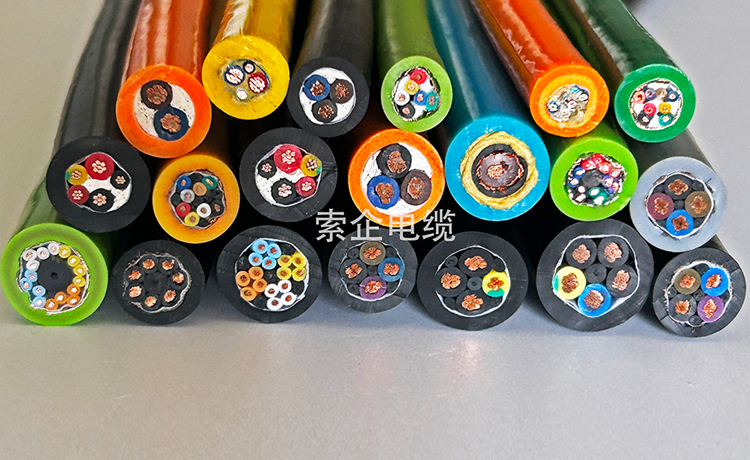
The conductor is formed by twisting multiple strands of ultra-fine oxygen-free bare copper wire, providing good conductivity and flexibility, meeting the needs of frequent bending of cables. According to different application scenarios and customer requirements, the conductor can be tinned to further enhance its corrosion resistance, making it suitable for humid and highly corrosive environments.
Insulation layer
A variety of insulation material options are available, such as polyethylene (PE), polyvinyl chloride (PVC), cross-linked polyethylene (XLPE), and polyperfluoroethylene propylene (FEP). PE insulation offers high flexibility and excellent signal transmission speed, making it suitable for high-speed data transmission scenarios with high signal transmission requirements; PVC insulation is economical and practical, with excellent electrical and mechanical properties, widely used in general industrial environments; XLPE insulation has excellent high-temperature and aging resistance, suitable for high-temperature environments; FEP insulation has outstanding resistance to high and low temperatures and corrosion, making it suitable for extremely harsh environments.
Sheath
In addition to the previously mentioned PUR and modified PVC sheaths, other sheath materials can also be provided according to special customer requirements, such as special waterproof elastomer sheaths. These sheaths not only have excellent waterproof performance but also feature outstanding flexibility and tear resistance, making them suitable for underwater equipment and cable carrier systems in humid environments. Some cables adopt a dual-layer structure with an inner sheath and an outer sheath, where the inner sheath provides additional insulation and protection, while the outer sheath focuses on enhancing the cable's wear resistance, weather resistance, and other properties, further improving the overall performance and service life of the cable.
Reinforce the component
According to the tensile requirements of the cable usage scenario, flexibly configure different types and numbers of reinforcing elements. In addition to galvanized steel wire, aramid fiber, and Kevlar fiber, other high-strength materials can also be used as reinforcing elements to ensure that the internal structure of the cable remains stable under different levels of tensile force and that transmission performance is not affected.
Shielding layer
For applications requiring electromagnetic shielding, a variety of shielding structure options are available. Tin-plated copper mesh shielding has a braiding density of ≥80%, effectively shielding against external electromagnetic interference; Aluminum foil shielding offers excellent shielding performance and flexibility, suitable for applications requiring high cable flexibility; Double-layer shielding structures (such as aluminum foil and tinned copper mesh) provide stronger shielding performance, meeting application scenarios with extremely high electromagnetic compatibility requirements such as precision equipment and medical devices.
Our drag chain cables, with their excellent performance and flexible, diverse product structure, are widely used in industrial automation production lines, CNC machine tools, logistics and warehousing equipment, port machinery, robots, medical equipment, and many other fields, providing reliable support for the stable operation of equipment in various industries. Choosing our drag chain cables is choosing efficiency, stability, and peace of mind, helping your company stand out in a fiercely competitive market.
