Category: Products
Hotline
Tel: +86 133 1175 6197
WeChat: L13311756197
Email: postmaster@suoqi-cable.com
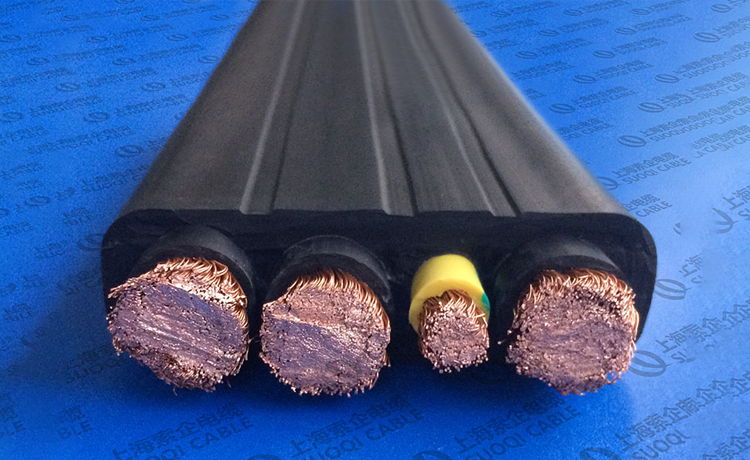
Product details of cables for Shanghai cable-type bridge (beam bridge) cranes
1. Product positioning and application scenarios
Precisely adapting to the core requirements of bridge cranes specifically designed for bridge cranes (including beam bridge, suspended, general-purpose bridge types, etc.), deeply adapting to their three-dimensional movement trajectories (hoisting, transverse, longitudinal) and continuous cable reeling and unloading operation scenarios. Widely used in:
Industrial Manufacturing: Hoisting heavy equipment in workshops such as steel mills, machining plants, and automobile manufacturing plants.
Warehousing and logistics: intelligent warehousing systems, automated high-bay warehouse cargo handling;
Energy and Power: installation of boiler equipment in power plants, transformer hoisting, and other power facility operations;
Rail transit: Metro construction, high-speed rail carriage assembly, and other rail engineering scenarios.
Adaptability to working conditions: Able to withstand high-frequency bending during crane operation (thousands of daily retracting and unloading), strong tensile forces (tensile tensile force of several tons when lifting heavy loads), oil stains/iron filings contamination, and dust/humid hot environments in workshops, ensuring 24-hour continuous operation and stable power supply.
2. Core Technology Advantages
1. Tensile and torsional resistance, outstanding dynamic load capacity
Double-layer tensile structure:
Inner layer: braided layer of multiple high-strength aramid fibers, dispersing more than 90% of axial tension, with a single cable tensile strength up to **[X] N** (equivalent to lifting a 2-ton weight);
Outer layer: Kevlar torsion-resistant braided layer, suppresses the spiral deformation of the cable during rotary motion, with a torsional moment up to **[X] N·m**, preventing core wire breakage caused by 'twisting'.
Dynamic bending test: After 100,000 bending cycles (bending radius 8D, D being the cable outer diameter), the conductor breakage rate is less than 0.5%, far exceeding national standard requirements.
2. Wear-resistant and corrosion-resistant, capable of harsh environments
Sheath material upgrade:
Standard imported PUR (polyurethane) sheath, surface hardness Shore A90, wear resistance five times that of ordinary rubber, able to withstand scratches from iron filings and gravel;
For special conditions, a nitrile rubber (NBR) sheath is optional, resistant to engine oil and hydraulic oil corrosion, passing ASTM D471 oil immersion test (70℃ × 168 hours), volume change rate <3%.
Environmental tolerance:
Temperature range: -40℃ (cold storage) to 80℃ (high-temperature workshop in steel plants), for extreme environments a 125℃ silicone rubber insulation is optional;
Protection level: IP67 waterproof (no penetration when submerged in 1 meter of water for 30 minutes), IP54 dustproof, suitable for outdoor rain and snow as well as workshop dust conditions.
3. Stable electrical performance, zero transmission delay
Conductor optimization:
Uses 99.99% high-purity oxygen-free copper (conductivity ≥100% IACS), tightly twisted fine copper strands (diameter 0.12mm × 265 strands), conductor DC resistance <0.727Ω/km (16mm² specification), reducing energy loss by 15%;
Meets IEC 60228 Class 6 standard (ultra-fine stranding), stress distribution between strands is more uniform when bending, preventing single-strand breakage.
Insulation and shielding:
The insulation layer uses cross-linked polyethylene (XLPE) or silicone rubber, with a dielectric strength > 30kV/mm and breakdown resistance up to 15kV;
Control cables come standard with dual shielding of aluminum foil and tin-plated copper mesh, with a shielding efficiency of ≥99.9%, resistant to electromagnetic interference from inverters and motors, and signal transmission delay < 0.1μs.
3. Structural Design and Specification Parameters
1. Typical structural decomposition
Structural layer
Materials / Craftsmanship
Function description
Conductor
Multi-strand Finely Stranded Oxygen-Free Copper Wire (Class 5/6)
Highly flexible conductivity, suitable for high-frequency bending
Insulation
Special PVC/NBR/PUR/XLPE
Electrical isolation, oil-resistant, high-temperature, and chemical corrosion resistant
Tensile reinforcement layer
Aramid fiber braid, galvanized soft steel wire (optional)
Withstands mechanical tension to prevent cables from sagging or breaking
Torsional layer
Kevlar fiber spiral winding
Inhibit torsional deformation, maintain structural stability
Sheath
PUR/NBR/silicone rubber, black / gray (customizable colors)
Wear-resistant outer protection, suitable for different environmental media
2. Mainstream specification tables
Model
Number of cores: × cross-sectional area
Rated voltage
Minimum bending radius
Fixed bending radius
Reference weight (kg/km)
12×1.5 (control cable)
Note: Supports custom pin count (2-61 pins), cross-sectional area (0.75-120mm²), and special voltage levels (such as 3.6/6kV).
Selection Tips
This configuration is used for power connection in engineering renovations, with an emphasis on enhancing salt spray resistance and hydrolysis resistance. Common specifications are generally available in stock. If the working conditions involve high-frequency bending, oil contamination, or salt spray, it can be specified when ordering, and technical personnel will match the corresponding structure.
